
SPAN is seeking academics and research representatives to speak with Access Partnership about the potential implications of the EU Space Act for their institutions, research activities and international collaborations. These interviews form part of a study commissioned by the Space Partnership.
We are keen to capture a range of perspectives, including those of universities, research organisations, spin-outs and teams involved in ESA missions.
We would particularly welcome examples of UK university collaborations with partners in the US or other non-EU countries to build an instrument, develop a payload or deliver a data service independently of ESA programmes.
These examples are not exhaustive. If your work offers another relevant perspective, I would welcome your suggestions and be happy to introduce you to Access Partnership.
To express an interest or suggest a case study, please email me at as1300@leicester.ac.uk as soon as possible.

What is the EU Space Act?
The EU Space Act is a legislative initiative by the European Commission that introduces a harmonised framework for space activities across the Union. The proposal, launched on 25 June 2025, aims to ensure safety, resilience, and environmental sustainability, while boosting the competitiveness of the EU space sector.
Europe’s current regulatory landscape is fragmented—13 different national approaches increase complexity and costs for businesses.
The EU Space Act will create a single market for space activities, making it easier for companies, particularly start-ups and SMEs, to grow and operate across borders.
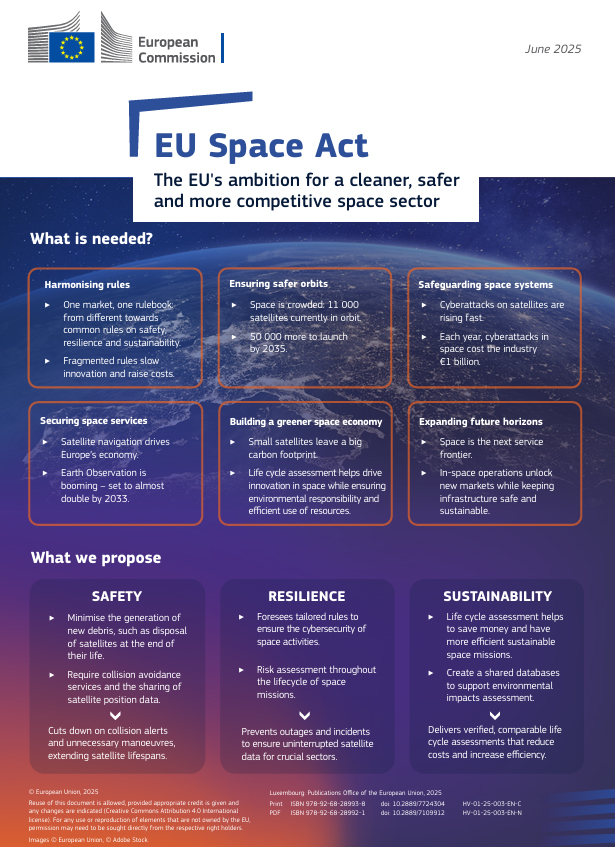
EU Space Act: Implications for UK Universities
This summary is based on the Council’s latest text of the proposed EU Space Act from August 2026. As the Act is still under negotiation, the details may change. The UK is classified as a “third country” under the Act, meaning UK universities and research institutes mainly come into scope if they provide space services or space data into the EU.
The Good
Sharing data for research is not caught: The Council text says that providing space data “for purely research or educational purposes” does not count as providing space data under the Act. Normal research collaboration with EU partners should therefore not trigger the Act’s data rules.
Current and near-term missions are out of scope: The Act does not cover satellites launched before a cut-off date: three years after the Act comes into force. Satellites already in orbit, and those launching in the next few years, would not be affected.
The Bad
Extra EU paperwork on top of the CAA licence: A UK university providing space services or data into the EU would need several things on top of its UK licence from the Civil Aviation Authority (CAA) such as:
EU registration, with a Commission decision that can take up to 12 months
A legal representative based in the EU.
A contract with a collision-avoidance provider.
The exception is if the EU recognises UK rules as equivalent.
The environmental break may not apply: The Act’s environmental footprint rules extend to non-EU operators. However, the relief given to universities is not extended to them: the exemption for technology demonstration missions and the exemption until 2031. As drafted, a UK university mission could face stricter environmental reporting than a comparable EU university mission.
The Ugly
It’s unclear whether the lighter safety rules apply: The text lists the research “light regime” among the rules for non-EU operators. But the light regime itself refers only to EU operators. This needs clarifying, for example on whether a small UK research satellite could fly without a propulsion system.
Recognition of UK rules is possible but not guaranteed: The Act allows the EU to recognise a non-EU country’s rule as equivalent. UK operators with a CAA licence would then be treated as compliant. However, this needs:
A detailed EU assessment.
The UK to recognise EU rules in return.
Renewal after a fixed period.
Next steps
Please help us to share this information to your colleagues.
To express an interest or suggest a case study, please email me at as1300@leicester.ac.uk as soon as possible so we can share the next steps.
Dr Junayd Miah from the Access Partnership will be joining our upcoming SPAN Town Hall on Thursday 19th November to outline the EUSA and what it could mean for our community.
14 September 2026
SPAN meetings offer key opportunities to collaborate, share ideas, and hear updates on papers in development. Your input is welcome and vital to shaping this work.
08 September 2026
We shared yesterday the news that the Government has published the new UK Space Strategy, alongside its Technical Delivery Annex. Ahead of publication, SPAN was invited to provide a response from our Co-Chairs, Professors Anna Hogg and Mark Sims. Their statement has been included in the Government's announcement:
10 August 2026
Over the summer Anushka Sharma had the privilege of moderating discussions and speaking on panels across the UK space sector, from security and defence at Farnborough International Airshow, to running a session on SPAN at the National Astronomy Meeting in Birmingham, and most recently joining a panel on DWC Resilience forum hosted at Fieldfisher
