
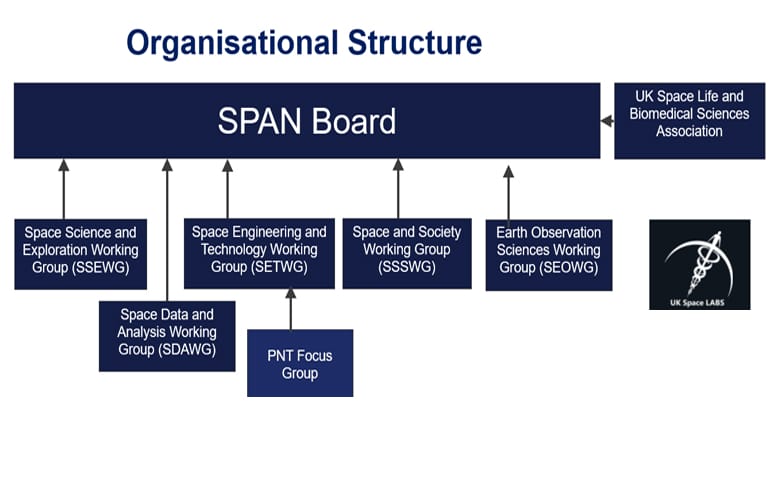
SPAN provides a national voice for space-related research in the UK across Earth Observation, Space Engineering, Space Science and Exploration. Each area is supported by a dedicated Working Group, providing a forum for discussion, collaboration and knowledge exchange across the academic community.
SPAN also hosts a Data and Analysis Working Group, bringing together expertise across Earth Observation, Space Science and Exploration.
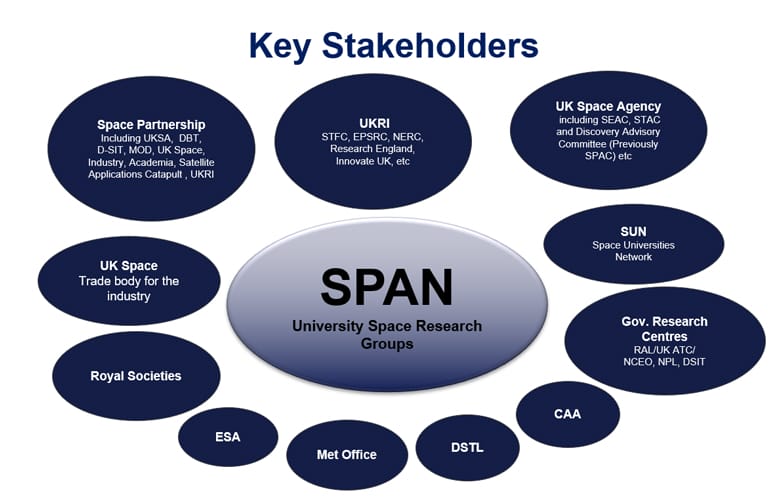
SPAN welcomes new members and works collaboratively with research organisations and networks across the UK space sector, strengthening connections, sharing expertise and supporting collaboration across the community.
See our Working Group meeting dates to find out when the next meetings are taking place.
New members are always welcome. Join a Working Group or sign up to the SPAN newsletter to stay connected and get involved. For more information, please contact info@span.ac.uk.
The ability to observe our planet from space has led to a huge growth in the understanding of our planet, its climate and its resources. Earth Observation covers all aspects of studying the Earth from space including the development of instrumentation, its operation and the processing, analysis, publication and application of its data.
The use of technology in space and in support of space assets involves many novel challenges associated with the launch, environment and remoteness. Space Engineering addresses these issues and, like any other branch of engineering, brings forward new and novel technologies that enables our exploitation of space for both commercial and scientific benefit. There is a Position, Navigation and Timing (PNT) Sub Group currently integrated in this Working Group.
Our understanding of the universe is enhanced by observing above the atmosphere and in the close proximity of celestial bodies (such as within a magnetosphere, on the surface of planets, near the Sun or in orbit around a comet). Space Science covers diverse subjects including Astronomy and Astrophysics, Planetary Science, Solar Physics and Solar-Terrestrial Physics. Space Science also includes the measurement of fundamental physical constants from space (such as the equivalence principle), high energy particles and gravitational physics including gravitational waves.
Space missions are generating massive and complex data sets, ranging from remote sensing of our Earth with Copernicus Sentinel’s, to mapping our Galaxy with Gaia, or the distant Universe with Euclid. The analysis and federation of multiple data streams together with tools to effectively mine these peta- and, increasingly, exascale-datasets is a key to maximising the economic, societal and scientific benefits from these space investments. This WG provides a forum to develop best practice space data policy, leveraging emerging state of the art data technologies and techniques, in the development and operations of cutting edge space research missions.
The wider impact of Space as a domain as well as its impact on all aspects of society is an area of great interest. Sustainability, Space Law, Ethics and Regulation will play a crucial role in its impact across all of society, not just in space faring nations but those that can play a critical part of the wider infrastructure of society.
14 September 2026
SPAN meetings offer key opportunities to collaborate, share ideas, and hear updates on papers in development. Your input is welcome and vital to shaping this work.
08 September 2026
We shared yesterday the news that the Government has published the new UK Space Strategy, alongside its Technical Delivery Annex. Ahead of publication, SPAN was invited to provide a response from our Co-Chairs, Professors Anna Hogg and Mark Sims. Their statement has been included in the Government's announcement:
10 August 2026
Over the summer Anushka Sharma had the privilege of moderating discussions and speaking on panels across the UK space sector, from security and defence at Farnborough International Airshow, to running a session on SPAN at the National Astronomy Meeting in Birmingham, and most recently joining a panel on DWC Resilience forum hosted at Fieldfisher
